

Your score report is a technical document dressed as a verdict. A PTE 73, an IELTS 7.5 overall with 6.5 in writing, or an OET B in three skills and C+ in one each tell a different story — and each authority in Australia reads them differently. Department of Home Affairs points tests, university admissions, and AHPRA registration do not share one universal pass line. This article explains what the numbers on the page actually measure, where integrated tasks blur skill boundaries, and how to turn a disappointing line item into a study plan instead of another expensive guess.

Start with the authority, not the forum post
Before you interpret a single digit, open the requirement that governs your outcome. Skilled migration English thresholds on the Department of Home Affairs website are not identical to a nursing board's OET rule or a university's IELTS condition. Social media "PTE 65 equals IELTS 7" charts are approximations; your visa delegate or admissions officer applies the policy in force on the day of decision.
Exams report performance on timed tasks against published criteria — not study hours, not how close you feel to ready. That distinction matters when a result stings: the fix is usually an identifiable sub-skill, not a character judgment.
- Read per-skill minimums first. An overall band or PTE total can look fine while one skill blocks your application.
- PTE enabling skills are diagnostic. Low spelling or oral fluency often explains multiple communicative dips.
- IELTS writing and speaking are human-marked. Half-band gaps map to descriptor levels — study the public rubrics.
- OET is profession-specific. A grade acceptable for one AHPRA pathway may not suit another.
- Mocks trend; officials decide. Portal scores guide practice — they do not guarantee the next sitting.
PTE Academic: why the overall is not an average
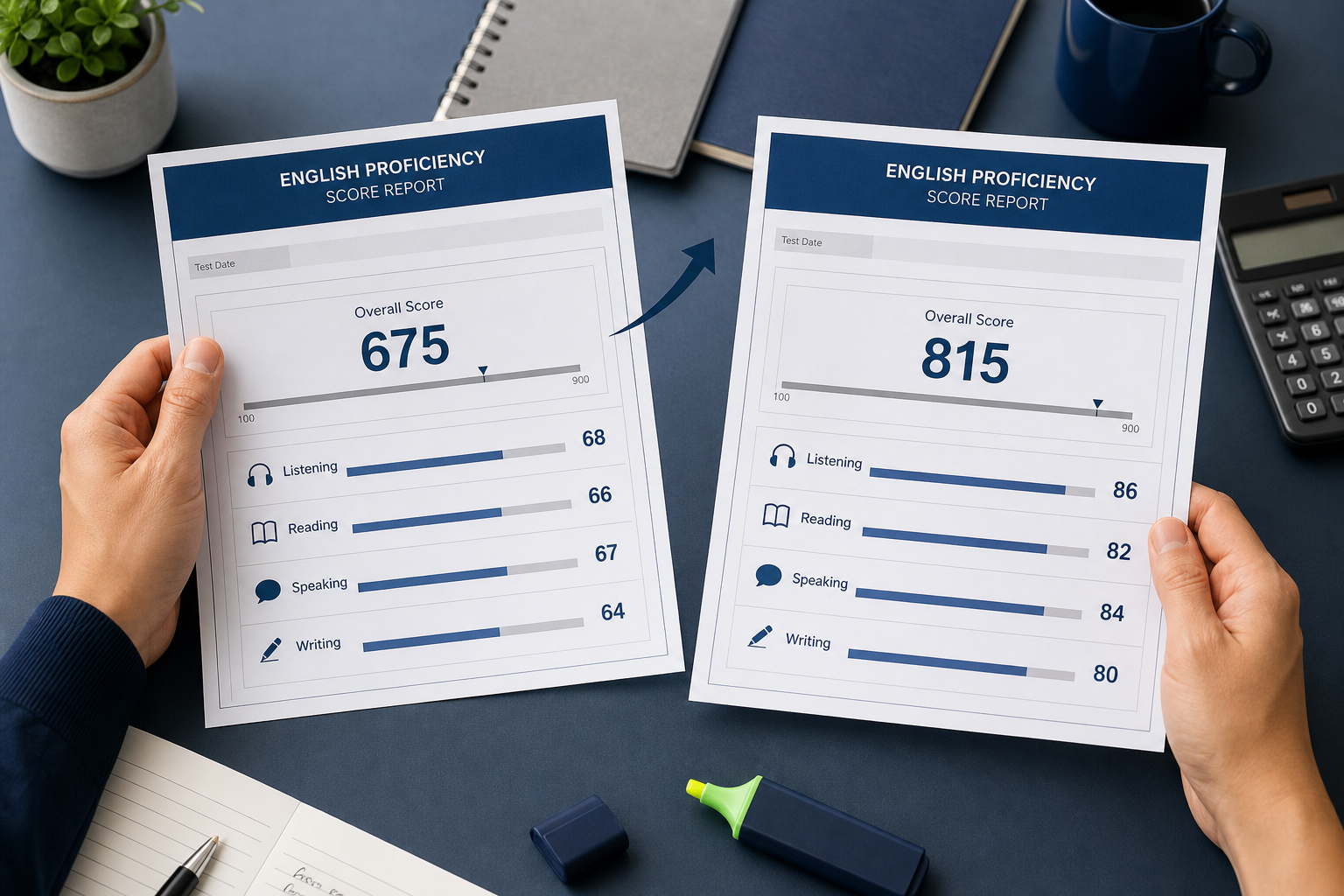
PTE reports an overall score from 10–90 plus communicative scores for listening, reading, writing, and speaking on the same scale. Enabling skills — grammar, oral fluency, pronunciation, spelling, vocabulary, written discourse — sit underneath and explain cross-task leakage.
Read Aloud contributes to speaking and reading. Repeat Sentence hits listening and speaking. Write from Dictation links listening and writing. A candidate who scores 79 in reading but 65 in speaking may have strong comprehension yet lose marks on pronunciation affecting several integrated items — not "bad speaking" in isolation.
When communicative scores cluster oddly, open enabling skills before booking another full test. Ten focused sessions on written discourse or spelling often move writing faster than repeating unrelated essays.
IELTS bands and the overall calculation
Each skill is reported from 0–9 in half-band steps. The overall band is derived from the four communicative scores using IELTS rounding rules — treat published examples as authoritative rather than mental arithmetic. A 7.0 in listening, 7.5 in reading, 6.5 in writing, and 7.0 in speaking does not always round where intuition suggests; verify with official guidance when you are borderline.
Australian skilled migration commonly cites "competent English" or "proficient English" with specific band combinations. A 8.0 overall with 6.5 in writing still fails a 7.0-each requirement. Universities may waive one skill for packaged pathways; visas rarely do.
Writing and speaking descriptors are public. If an examiner awarded 6.5 instead of 7.0 on Task Response or Fluency, the gap is visible in the language of the rubric — "addresses all parts of the task" vs "presents a clear position throughout." Translate disappointment into descriptor targets for your next IELTS Preparation block.
Per-skill floors matter more than bragging rights
Chasing a flashy overall while one skill sits below threshold is how candidates burn four sittings. Identify the failing line on the report, compare it to the authority's table, and study that skill until mocks show a stable margin — not a single lucky practice test.
OET grades for healthcare registration
OET reports A–E (or numeric equivalents on some score displays) per listening, reading, writing, and speaking. ANMAC and other nursing assessors have historically required minimum B grades in specified skills; medical and pharmacy boards publish their own tables. A B in writing with C+ in speaking is not "almost there" — it is a fail until that skill clears the line.
Because tasks are clinical, a strong IELTS history does not automatically predict OET success. Letter layout and role-play empathy markers are scored explicitly. OET Training aligned to your profession beats generic essay feedback.
When official and mock scores disagree
H&H Academy portal mocks simulate timing and item types, but they cannot replicate Pearson's item bank draw, IDP/British Council seating, or OET's live role-play partner. Expect a band of normal variance — plus environment effects: booth noise, keyboard feel, identity checks, cumulative fatigue.
Use mocks to spot trends across four to six weeks. Rising enabling skills on PTE, stable descriptor feedback on IELTS writing, or consistent OET Bs in coaching role-plays are better green lights than one outlier mock. Plateau despite targeted work means change the drill, the item type focus, or the test choice — not simply "sit again."
Archive official PDFs securely; you will upload them to ImmiAccount, university portals, or AHPRA more than once. If you meet threshold, stop testing. Extra points rarely justify another sitting risk.
Turn the report into a four-step plan
Step 1: Highlight each skill against your authority's current minimum. Step 2: Find the largest gap; that is your primary study block unless another skill is below floor. Step 3: For PTE, map enabling skills to drills; for IELTS/OET, map descriptor language to task types. Step 4: Rebook only when mocks — reviewed by a coach — show repeatable margin, not hope.
Skill work is concrete: speaking fluency and booth technique in speaking strategies for English exams; timed planning and proofreading in writing under exam conditions. Structured item practice lives in the Practice Portal for PTE, IELTS, and OET enrollees.
Unsure which exam fits your pathway? Book a consultation before you pay for another registration you do not need.
Back to Blog View CoursesVerify English score thresholds on official Department of Home Affairs, university, or AHPRA pages at the time you lodge your application.