

Universities, the Department of Home Affairs, and plenty of employers still ask for IELTS by name. H&H Academy prepares Academic and General Training modules from public band descriptors — timed writing, live-style speaking practice, listening where one mis-spelled plural costs a mark — with a plain answer on when you are actually ready to book.
Academic for tertiary study; General Training for migration and many work contexts
Listening, Reading, Writing, Speaking — each banded 0–9, overall averaged
Computer-delivered or paper-based at authorised centres — content equivalent
Hornsby and online; typical programs six to fourteen weeks
Academic or General Training — decide before you pay
Academic reading draws on scholarly passages; Writing Task 1 describes charts, tables, or processes. General Training reading reflects workplace and everyday texts; Task 1 is a letter — formal complaint, semi-formal workplace note, or informal note to a friend — matching the brief exactly.
Listening and Speaking formats are shared, but Writing and Reading are not interchangeable. Registering for the wrong module is not fixable at the desk. Bring your offer letter or visa paperwork to consultation. If the document allows PTE, we can contrast that path on the courses page and in PTE coaching.
Band scale and what we train at each level
| Band | Plain reading | Typical coaching emphasis |
|---|---|---|
| 5.0 – 5.5 | Partial command; frequent breakdowns | Task structure, core grammar, survival vocabulary |
| 6.0 – 6.5 | Effective with noticeable errors | Cohesion, fuller Task 2 development, speaking pace |
| 7.0 – 7.5 | Good control; occasional slips | Lexical precision, fewer article errors, tighter Task 1 overview |
| 8.0+ | Very strong; rare errors | Polish, eliminating fossilised mistakes, discourse control |
Institutions may require a minimum overall band, minimums per skill, or both. A 7.0 overall with 6.5 writing fails where writing 7.0 is stated. We plan from the exact wording in your letter.
Listening
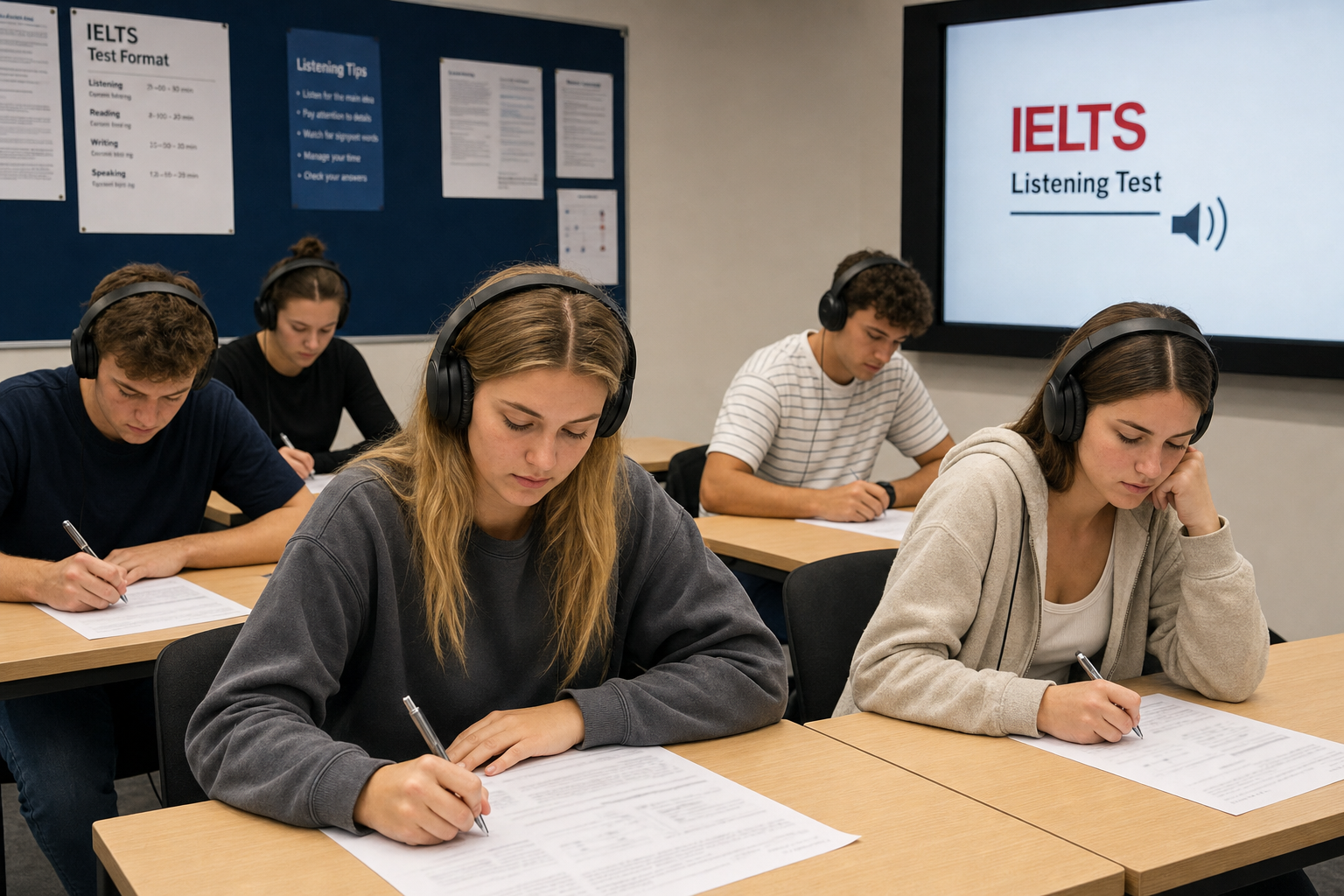
Four sections, rising difficulty; answers must match required grammatical form and spelling.
Reading
Three long passages; managing twenty minutes per passage separates 6.5 from 7.0.
Writing
Task 1 (150 words) and Task 2 (250 words) — task achievement weighed with cohesion and range.
Speaking
Three-part interview recorded; fluency means sustained speech, not racing without breath.
Preparation framework
Diagnostic across four skills where feasible. A strong listener with chaotic Task 2 structure gets a different weekly plan than a fluent speaker who drops articles in every sentence.
Writing feedback quotes band descriptors — “referencing unclear in paragraph two,” not “expand ideas.” Speaking uses mock interviews with follow-up questions like real examiners. Reading homework explains why a trap option almost worked.
Portal timed sets, model answers for analysis (not memorisation), and self-review checklists fill the days between classes. Intensive cohorts sit full mocks at fixed milestones; results reset the next fortnight’s priorities.
- Separate Academic and General Training reading and writing tracks
- Task 1 and Task 2 frameworks flexed to your level
- Speaking Parts 1–3 with pronunciation where intelligibility slips
- Listening plural and spelling traps drilled systematically
- Reading tactics for headings, T/F/NG, and gap-fill tasks

Writing and speaking depth
Task 1 Academic: overview first, logical grouping, language for trends — no opinion paragraphs smuggled in. Task 1 General: register matches audience — who receives the letter and why.
Task 2: every part of the prompt answered; position visible; body paragraphs developed; conclusion that does not invent new arguments. We avoid memorised shells that examiners recognise in the first line.
Speaking Part 2: notes that survive thirty seconds of silence; Part 3 answers that extend rather than repeat Part 2 in one word.
Who enrols — and what we refuse to promise
Conditional university offers, skilled migration cases, professional registration, repeat sitters stuck on one band — all common here. Self-study apps rarely fix writing or speaking because nobody marks your work against the descriptor sheet.
We do not guarantee a band. We do guarantee a written plan, regular measurement, and the word wait when mocks say wait. Official fees go to your test centre at registration; our fees cover tuition, portal, marked tasks, and mocks listed in your enrolment letter.
Repeat candidates
Bring every TRF. We map which criterion stalled — task achievement, coherence, lexical resource, grammar, pronunciation — and shorten the program to that gap where possible. Sitting again unchanged is the expensive option.

Weekly habits: one editorial read aloud for pronunciation; one timed Task 2; one recorded Part 2 long turn reviewed against a checklist. Small repeats beat weekend marathons.
Book consultation
Sessions in person at our Hornsby learning centre or online across Australia. Email info@hnhacademy.com.au with your target bands and sitting window.
Book a Consultation Send an Enquiry